Chicken or the Egg Family & Firsts at Woodbury Hatchery
Written By: Melinda Goodman
Photos: Ron Rouse
There’s a moment, just before a chick breaks through its shell, when everything is quiet.
No movement. No sound. Just life, pressing outward.
And then, barely audible at first, a peep. At Woodbury Hatchery, that sound marks the beginning of everything. With thousands of chicks every hatch day, it’s not just audible, it’s cacophony.
A Hobby, An Education, An Accidental Opportunity
As a farm kid, whose parents took on extra work to give me opportunities, I understand the sentiment Todd Woodbury shares when he says he did it to share with his kids. That’s the thing with generational agriculture. It requires vision for the future. It’s why farmers are the true optimists — planting a seed and hoping for rain or placing an egg in an incubator and waiting for a chick.
Todd has always loved chickens. As a rancher’s son, it wasn’t the cows that held his interest, it was chickens. By age eight or nine, he was already incubating eggs and reading everything he could. There was even a time he had to be convinced to join family movie night versus reading a book about chickens, a story his sister still likes to tell.
But the hatchery didn’t start there. It began just a few years ago with an idea for his kids.
Through 4-H, the kids began raising chickens and learning what it meant to care for animals. Todd wanted them to understand the full cycle. In 2019, they set up breeding pens, incubated eggs, and selected show birds. A 300-egg incubator quickly proved to be more than one family needed so they sold some to neighbors.
A few months later, around the dinner table Todd asked, “Hey kids, do you want to raise chicks to sell?”
Everyone said yes.
They named it Woodbury Hatchery, built a website and Facebook page, and launched the business in February 2020 — just weeks before everything changed.
“There were so many calls,” Todd says. “We were not prepared.”
People inquired about buying chicks and if Woodbury Hatchery could help them get started. He said yes.
As more people turned toward home-based food production during the COVID-19 pandemic, interest surged. Backyard chickens became more than a novelty. They offered a sense of food security and independence and a way to understand where food comes from.
What began as a family project became a full-blown business almost overnight.
A 300-egg incubator became 7,000…then 76,000.
Today, Woodbury Hatchery produces about 200,000 chicks per year and is the largest hatchery in North Dakota. Todd, Rebecca and their four kids are deeply involved, along with several employees who help with everything from egg collection and deliveries to hatch day. The work requires all of them.
Because none of the steps are small. Every step matters. Every step happens on a timeline. Every day of the week.
The Hidden Complexity of a Chick
To the average customer, a chick is simple: small, fluffy, cute, and ready to take home.
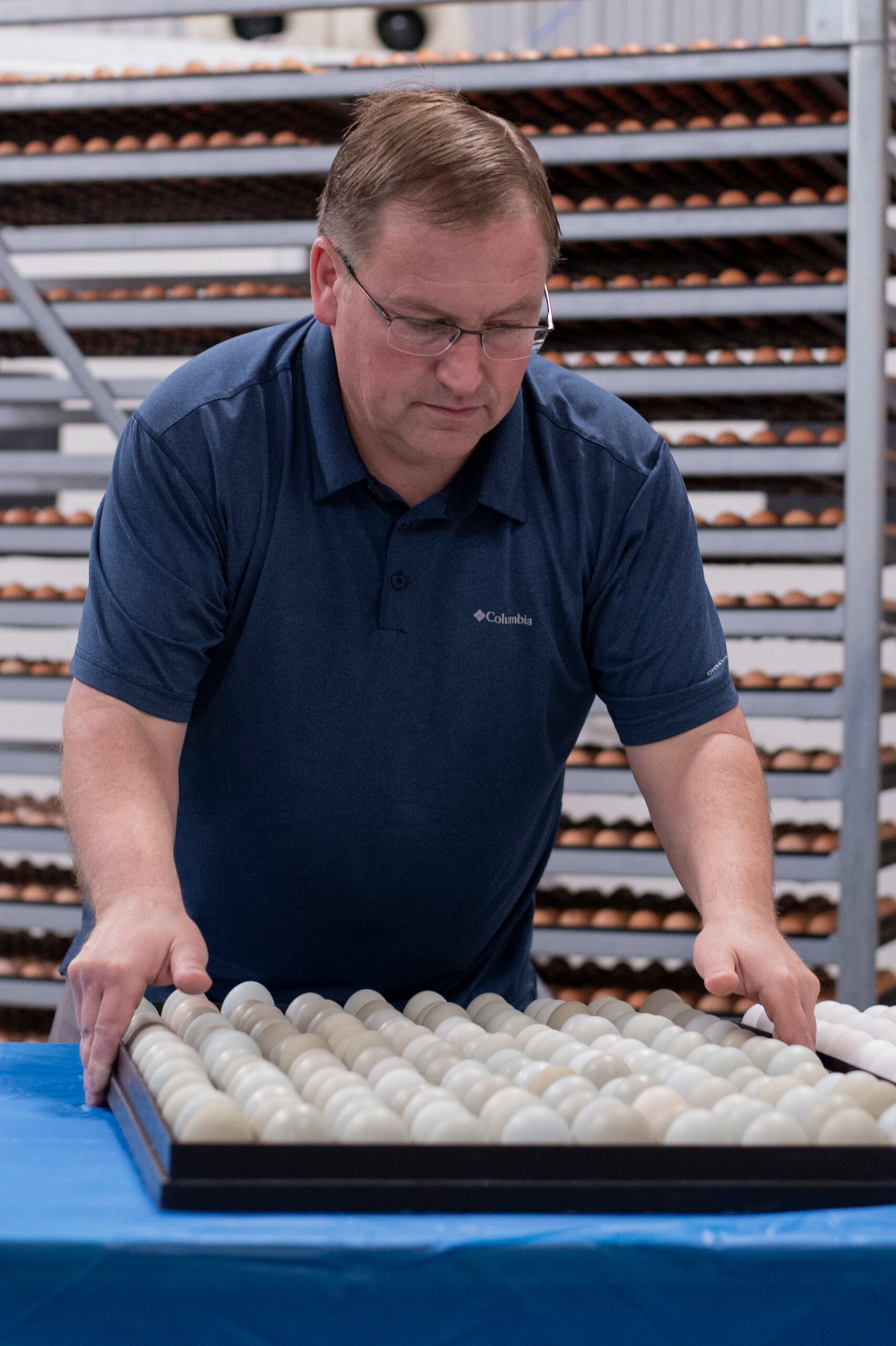
Behind that simplicity is a tightly managed biological process. It starts with breeding flocks that include carefully selected hens and roosters on controlled diets. Fertilized eggs are collected multiple times a day and stored in climate-controlled conditions before incubation.
Each day involves cleaning, sanitizing, and preparation for hatch day.
Once the eggs are in the incubator, temperature, humidity, and airflow must be precise. Even small fluctuations matter. For 18 days, eggs are turned mechanically, mimicking a hen which prevents the embryo from sticking. Trays are labeled by date and species. Eggs are candled to monitor development and remove nonviable eggs.
Around day 18, eggs are moved to hatching trays. The chicks position themselves. And then, around day 20 or 21, it begins.
Hatch Day
If incubation is the quiet before the storm, hatch day is anything but.
Chicks emerge over an approximately 24-hour window; some early, some late. Timing varies. Inside the hatchers, movement builds. Wet chicks dry into fluff. Shells crack. The pace accelerates.
Chicks are pulled, sorted, counted, and prepared for pickup or shipping. They must be handled carefully, kept warm, and moved efficiently. “It’s busy,” Todd says.
On a typical hatch day, the Woodbury family and their helpers work through thousands of chicks. It’s a system built on timing, teamwork, and experience.
More Than Just Chickens
Woodbury Hatchery offers chickens, ducks, turkeys, and guineas, serving everyone from backyard hobbyists to small farms.
Within chickens, breeds are selected for specific purposes:
- Layers like Hy-Line Browns or Lohmann Browns for egg production
- Broilers like Dakota Whites and Reds or Cornish Cross for meat birds
- Others for hardiness, temperament, or egg color
Todd focuses on practicality. Birds need to handle the climate, produce consistently, and meet customer goals whether eggs for the kitchen or meat for the freezer. In fact, Todd shares that he spends a significant amount of time on the phone with customers learning what they want so he can recommend the right breeds for their needs.
A Growing Movement: Backyard Chickens
A hatchery sits at one of the earliest points in the food system. Before eggs. Before meat. Before markets or meals. For many customers, buying chicks is the beginning of their food journey.
Interest in raising chickens has grown; driven by cost, control, and a desire to reconnect with food. Like gardening, it’s approachable and quickly teaches that food doesn’t simply appear. It’s work.
“Chickens are one of the easiest ways to understand the process of producing food,” Todd says.
Even a small flock can shift perspective and many urban cities like Grand Forks, Mandan, Williston, Jamestown, Fargo and West Fargo have updated zoning laws to allow even city dwellers to have a chicken or two.
Getting Started: What You Need to Know
For first-time owners, the needs and surprises are often simple. Chicks need heat, clean water, and consistent care as they grow quickly.
Layer hens begin producing around 18–22 weeks. Meat birds can be ready in 8–9 weeks.
Todd recommends starting small. Equipment doesn’t need to be elaborate, but it does need to be right. The average owner will need a small coop or building, a feeder, and a waterer.
Once supplies are acquired, it’s time to purchase your chicks. Woodbury Hatchery ships throughout North Dakota, South Dakota, and Minnesota via Spee-Dee Delivery, or you can pick them up at the Hatchery. Minimum delivery orders are 15 chicks, but if you pick up, your order can be as small as one.
Behind the Scenes: A Family Business
Despite its scale, Woodbury Hatchery is a family business. Todd’s kids have grown up in it: early mornings, late nights, hatch day highs, and sometimes exhaustion.
Even with the added work, Todd still loves chickens and learning about them – reading, networking, attending poultry conferences and, consulting with experts. That mindset has driven the hatchery’s growth.
It’s clear that you’ve got to love this job to do it. It’s not seasonal work. It’s daily – all day long. Incubators are always full. Hatch day comes every week. Even the periods of rest are short and filled with planning. They only take about ten weeks off from November to mid-January to reset, but even then, the breeder chickens still need care.
As demand grows, Todd is thinking about an expansion that would include new facilities and improved systems, while also navigating the challenges of labor in a rural area.
The future is grounded in optimism. He hopes what he’s building becomes an opportunity for his kids, or maybe even a business partner. Whatever the future holds, Todd is clear, “There will be a place for them here. But whatever they do, I want them to be happy.”
The Sound of It All
The day I visited, it was quiet. No chicks peeping. Maybe that made it the perfect day to visit and allow time for conversation and reflection. It was a reminder that every small business has pressures, uncertainty, and hope.
That’s what I love about agriculture. Even on the hardest days, you wake up believing tomorrow will be better.
And then you see it; a sunrise, a rain shower, a sprout pushing through soil, a chick breaking through. It’s chaotic. It’s constant. It’s alive. And through it, we feel a little more alive too.